
Which Is the Smallest River in Bihar? Know Its Name and Importance
Bihar is often described as the land of rivers. From the mighty Ganga to powerful tributaries like Kosi and Gandak, rivers define the state’s geography, economy, and daily life. While these large rivers receive most of the attention, several smaller rivers quietly flow across the region, supporting local ecosystems and communities.
Among all of them, one river is recognised as the smallest river in Bihar. Despite its modest size, it holds geographical and historical significance.
The Smallest River in Bihar
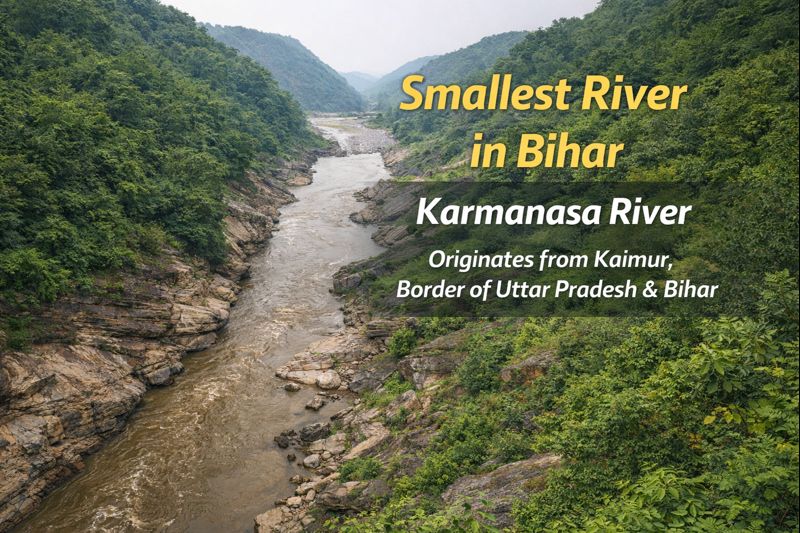
The Karmanasa River is considered the smallest river in Bihar.
It originates in the Kaimur region and flows along the border of Bihar and Uttar Pradesh before merging with the Ganga. Though smaller compared to other rivers in the state, Karmanasa plays an important role in marking boundaries, draining local regions, and shaping the landscape of southern Bihar.
A Brief Overview of Bihar’s River System
Bihar lies in eastern India, with Patna as its capital. It is one of the most densely populated states in the country and is known for its fertile plains formed by river deposits over centuries.
The Ganga flows through the heart of Bihar, supported by numerous tributaries originating from the Himalayas and the Vindhya ranges. These rivers support:
- Agriculture and irrigation
- Drinking water supply
- Local transport
- Cultural and religious traditions
While large rivers dominate the map, smaller rivers like Karmanasa are equally important at the regional level.
Origin and Course of the Karmanasa River
The Karmanasa River begins its journey in the Kaimur district, emerging from the northern slopes of the Kaimur Range at an elevation of around 350 metres.
From its source, the river:
- Flows north-westward through parts of Mirzapur in Uttar Pradesh
- Forms a natural boundary between Bihar and Uttar Pradesh for a significant stretch
- Finally joins the Ganga River near Chausa in Bihar
This border-forming role makes the river geographically important despite its smaller size.
Length and Drainage Area
The Karmanasa River has a total length of approximately 192 kilometres.
- Around 116 km flows through Uttar Pradesh
- About 76 km forms the inter-state boundary with Bihar
The river drains a catchment area of roughly 11,709 square kilometres, collecting water from surrounding hills and plains before meeting the Ganga.
Tributaries of the Karmanasa River
Though small, the Karmanasa River is supported by several minor tributaries that contribute to its flow. Some of the notable ones include:
- Durgavati
- Chandraprabha
- Karunti
- Goriya
- Khajuri
These tributaries help drain rainfall from the plateau regions into the plains.
Waterfalls Along the Karmanasa
As the river descends from the Kaimur hills into flatter land, it forms a series of scenic waterfalls. These falls are well known for their natural beauty and attract local visitors.
Major waterfalls along the river include:
- Karkatgarh Falls
- Devdari Falls, with a height of about 58 metres
- Chhanpathar Falls, around 30 metres high
These waterfalls highlight the river’s transition from rocky terrain to plains.
Historical Importance of the Karmanasa River
The Karmanasa River is closely linked to an important event in Indian history. The Battle of Chausa, fought on 26 June 1539, took place near its banks.
In this decisive battle:
- Sher Shah Suri defeated the Mughal emperor Humayun
- The victory marked a turning point in medieval Indian history
- Sher Shah Suri later established the Sur Empire
This event gives the river a place in historical records beyond its geographical role.
Why the Karmanasa Still Matters
Even though it is considered the smallest river in Bihar, the Karmanasa continues to be significant because:
- It acts as a natural boundary between two major states
- It supports local agriculture and groundwater recharge
- It contributes water to the Ganga basin
- It holds ecological, scenic, and historical value
Small rivers like Karmanasa remind us that size does not always determine importance.
Final Takeaway
The Karmanasa River holds the title of the smallest river in Bihar, stretching about 192 km from the Kaimur hills to the Ganga. While it may not be as famous as Bihar’s larger rivers, its role in geography, history, and local life makes it noteworthy.
In a state shaped by flowing water, even the smallest river has a story worth knowing.