
Which Colour Has the Longest Wavelength? Explained in Simple Terms
Light surrounds us every moment, yet most of us rarely stop to think about what it’s made of. What we see as white light is actually a mix of different colours, each behaving in its own unique way. One of the most important properties that sets these colours apart is wavelength.
Wavelength plays a big role in how far light travels, how clearly we see it, and why certain colours are used for warnings and signals. So, which colour has the longest wavelength in visible light? Let’s break it down clearly and simply.
The Colour with the Longest Wavelength
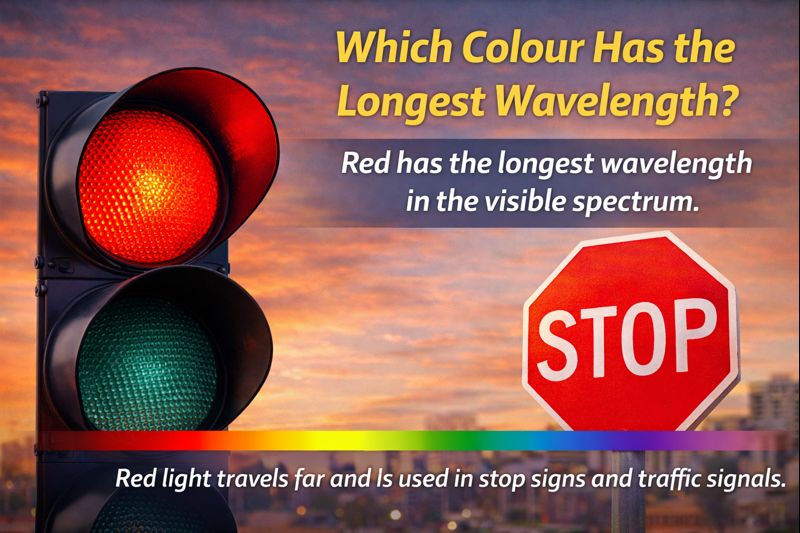
Red has the longest wavelength in the visible light spectrum.
In simple terms, red light waves are stretched out more than any other visible colour. Because of this, red light travels farther and scatters less when it passes through air, fog, rain, or dust. This makes red highly noticeable even from a long distance.
That single property explains why red is used almost everywhere when attention is critical—on stop signs, traffic signals, brake lights, and emergency warnings.
What Exactly Is Wavelength?
Wavelength is the distance between two repeating points of a wave, such as the top of one wave to the top of the next. If you imagine ocean waves, the space between two wave crests is similar to how wavelength works in light.
In the case of visible light:
- Wavelengths are extremely small
- They are measured in nanometres (nm)
- Shorter wavelengths carry more energy
- Longer wavelengths carry less energy
Even though we can’t see wavelengths directly, our eyes interpret them as different colours.
Visible Light Colours and Their Wavelengths
When white light passes through a prism, it splits into colours arranged by wavelength. This order never changes.
Here is the visible spectrum from longest to shortest wavelength:
- Red: ~620–750 nm
- Orange: ~590–620 nm
- Yellow: ~570–590 nm
- Green: ~495–570 nm
- Blue: ~450–495 nm
- Indigo: ~425–450 nm
- Violet: ~380–425 nm
Red sits at one extreme with the longest wavelength, while violet lies at the opposite end with the shortest.
Why Red Travels Farther Than Other Colours
Red light waves carry less energy and move more slowly compared to other visible colours. Because they are longer and less energetic, they are scattered less by particles in the air.
This is why:
- Red remains visible in fog, smoke, and heavy rain
- Red signals can be seen from a greater distance
- Red is ideal for warning and safety purposes
Red light is positioned right next to infrared radiation in the electromagnetic spectrum, which is known for its ability to travel long distances.
Why Traffic Signals and Stop Signs Are Red
The choice of red for stop signs and traffic lights isn’t random. It’s based on physics and human perception.
Red:
- Travels farther without scattering
- Stands out strongly against most backgrounds
- Signals danger or urgency naturally to the human brain
Even in poor visibility conditions, red is one of the last colours to fade, which makes it perfect for safety-related uses.
Interesting Facts About the Colour Red
- Red is the first colour to disappear underwater, turning grey or black at depths of around 15–20 feet.
- Mars appears red because its surface contains iron oxide, commonly known as rust.
- Many fast-food brands use red because it is believed to stimulate appetite and energy.
- During a lunar eclipse, the Moon can appear red, creating what is known as a Blood Moon.
- Across many cultures, red is often one of the first colours named after black and white.
Final Takeaway
The colour with the longest wavelength in visible light is red. Its extended wavelength allows it to travel farther, scatter less, and remain visible even in challenging conditions. This natural advantage explains why red plays such an important role in safety, signalling, and everyday life.
Understanding wavelengths doesn’t just explain colour—it helps us see why the world around us is designed the way it is.