Which Is the Longest Metro Route in India? The Answer Might Surprise You
Metro trains have quietly become an essential part of urban life in India. For millions of people, they are no longer just an alternative to buses or cars — they are the fastest and most dependable way to move across crowded cities. Whether it’s office-goers rushing to work, students heading to college, or families travelling across town, metro rail has reshaped daily commuting.
Amid the rapid expansion of metro projects across the country, one question often comes up: which metro route is the longest in India right now?
Let’s break it down clearly.
India’s Longest Metro Route at Present
Delhi Metro’s Pink Line Holds the Record
The title of India’s longest operational metro route currently belongs to the Pink Line of the Delhi Metro. Known officially as Line 7, this corridor is unique because it does not cut through the city centre. Instead, it wraps around Delhi in a broad arc, offering smoother cross-city movement.
This design helps passengers avoid overcrowded central stations while still connecting major residential and commercial areas.
How Long Is the Pink Line?
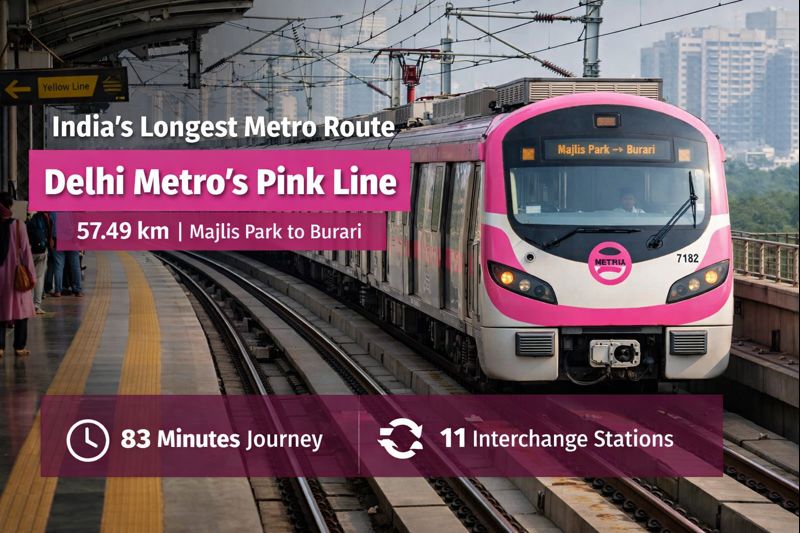
The Pink Line spans a total distance of 57.49 kilometres, making it the longest metro corridor that is fully operational in the country.
- Starting station: Majlis Park
- Ending station: Burari
Earlier, the route terminated at Shiv Vihar. However, with recent extensions, the line has expanded further north, bringing metro connectivity to fast-growing neighbourhoods that earlier depended heavily on road transport.
Stations Along the Route
The Pink Line has 45 stations planned in total.
- 38 stations are currently open to passengers
- 7 stations are still under development
Some of the key stations that serve large residential clusters and local markets include:
- Yamuna Vihar
- Bhajanpura
- Khajuri
- Sonia Vihar
- Jagatpur Village
- Jharoda Majra
- Burari
These stations play a crucial role in improving daily access for people living in North and East Delhi.
Travel Time and Passenger Convenience
Travelling from one end of the Pink Line to the other takes roughly 83 minutes. While this may seem long at first glance, the actual advantage lies in consistency — travel time remains largely predictable, even during peak traffic hours.
Seamless Interchanges Across Delhi
One of the biggest strengths of the Pink Line is its connectivity. The route includes 11 interchange stations, allowing passengers to switch easily to other metro lines. This makes it possible to travel across Delhi with fewer detours and less crowd-related stress.
For regular commuters, this means:
- Shorter overall journey time
- Fewer route changes
- Better access to different parts of the city
Which Metro Route Comes Second?
The Blue Line of the Delhi Metro ranks as the second-longest metro route in India.
- Length: 56.11 kilometres
- Route: Dwarka Sector 21 to Noida Electronic City
The Blue Line is among the busiest corridors in the country, linking Delhi with Noida’s IT and commercial zones while serving major residential areas along the way.
Delhi Metro’s Scale Compared to the Rest of India
Delhi Metro is not just home to the longest route — it also operates India’s largest metro network overall.
- Total network length: Around 350 kilometres
- Daily ridership: Approximately 2.5 to 3 million passengers
- Peak days: Passenger numbers can rise sharply during festivals and special occasions
With continuous expansion and upgrades, the network continues to set benchmarks for urban rail systems in India.
Why the Pink Line Matters Beyond Its Length
The importance of the Pink Line goes beyond record-breaking numbers. Its semi-circular design helps decongest heavily used central lines and brings metro access closer to areas that were previously underserved.
For the city, this means:
- Reduced pressure on main interchange hubs
- Better traffic distribution
- Lower dependence on private vehicles
For commuters, it simply means faster, more reliable travel.
The Bottom Line
As of now, Delhi Metro’s Pink Line, stretching 57.49 km, stands as the longest operational metro route in India. With strong connectivity, multiple interchanges, and growing coverage, it reflects how urban transport in India is evolving to meet real-world commuting needs.
With new metro corridors coming up in several cities, this record may change in the future — but for now, Delhi continues to lead the way.